What Matters

www.bible.com/1713/pro.21.21.csb

What really matters to you? What are you willing to sacrifice anything for to achieve or receive it? What really makes a difference in your life that you will allow nothing to interfere with?

Do you have one of those priorities? I’ve known heroin addicts that know exactly what this is like. There is no relationship, no possession they own that will not be sacrificed in order to get their next fix. They will rob from their mother and their grandmother to get what they need. That is the power of addiction. They will justify any act, any act, that will satisfy their need. Is there anything in your life like that?

Would you want a passion for Jesus like that? Could you?

Most people tend to rule their lives with the common good in mind, as long as it benefits self. I will go to work like everyone else, and I will endure that work as long as they continue to pay me every two weeks and I can take the occasional vacation. I will endure the twenty-odd years of marriage and have children like I am expected to, and then if I’m still happy with the person I married, I’ll stay with them. That’s what is expected, and as long as I am happy, I will continue. Do you see the nature of this addiction yet? This person is just as addicted as the Heroin addict. They are addicted to happiness, and are willing to do anything, even endure the ordinary, to keep it. This is the same person that will divorce because they are not happy anymore. They will find a better job because it will make them happy. Happiness, that ephemeral quality which cannot be grasped or kept, is an addiction.

So what does this verse tells us? Pursue righteousness (before God) and kindness (before men) and you will receive life, righteousness and honor. Life and righteousness come from God (This is the joy of living) and honor comes from men (being a voice that is respected is a powerful witness for the gospel).

Is it possible to be addicted to Jesus? Let me tell you that addiction to Jesus is the only true addiction you can ever have. Everything else will be governed by the law of diminishing returns. Every attempt to satisfy the need will result in less satisfaction, so you have to get more. With Jesus, the returns increase with use. He gives more every time you give Him your time. He becomes more profound, more satisfying, better with worship and study. Better with prayer and with service.

What is your priority? What matters to you? Maybe it’s time to examine yourself. Check your priorities. Ask others what they seem to be. You may be surprised.

God bless you today.

1000 – Source Code 8 – Steal No More

“You shall not steal.
(Exo 20:15)

 The Founders of America saw that this verse is an entitlement to personal property. If God considered it important enough to guarantee the safety of one’s goods in this way, the ability and the right to possess private property must be a God-given right. If it is wrong to steal, then it must be right to keep what you’ve earned through normal, legal means.

Thieves uniquely were not killed in penalty, but rather forced to pay back over and above the value of what they stole. They had to work to pay it back. It may sound like slavery, but sending someone to jail is worse than making someone work off their debt. This shows us that property in some ways equals time plus effort.

You spend your time working at a job to earn a paycheck, which you then in turn use to pay for things, like food, shelter, clothing, etc. These things represent your time. Time as we know is the most precious commodity we have, because we do not have an endless supply of it. Thus when something is stolen, it is a piece of someone’s life, not just property.

In the Law there is allowance made for sacrifices when a person lived too far away from the tabernacle. He could convert his animals he intended to sacrifice into money by selling them. Then, when he arrived at the tabernacle, he could then buy other animals to sacrifice on the altar. While he made his journey, his money represented his time and effort in raising pure animals for sacrifice. Our money does much the same thing. Our money represents the time and effort we sacrifice away from family and things that we want to do to do the things we have to do. Our paycheck represents the time and effort we spent working. This is in part why no one ever feels like they are being paid enough. To steal that money would be to steal your sacrifice.

Stealing is an easy way to acquire wealth, but it works against the soul. If the soul naturally is wont to work for its wealth, to acquire by earning, or “doing honest work” then stealing is its opposite. Stealing, like murder, takes the life of another person. There are implications for our modern world in this.

Consider for example taxes. Taxes are confiscated from your paycheck or during your transactions in very places at a percentage or a fixed portion. You have no choice but to pay them. You are submitted a portion of your time, your life, for things you have no choice in. Often the justification is that you are paying for publica services, like police, fire protection, new roads, and similar public works. That’s okay by me. But then my money is also being used to discover new uses for ketchup, how birds mate, and maintaining the lifestyle of a person who does not work, either by need or by choice. Some of my taxes are taken to pay to kill other potential future taxpayers before they are born. Not everything my taxes go for is by my choice or even my moral approval. Yet the tax burden never ceases, and every year more of my time is being spent in service to the state. Tell me what slavery is again?

And should we even talk about debt? Whether its student debt, credit card debt, housing debt, car loans, etc., as the proverb says, “the borrower is servant to the lender.” As long as you can work, you are still useful, and can pay your debts. But what happens when you are unable to work anymore? They come for your property. Now you may say that debt is something that you incur at your own risk. I choose to take on the debt, and sign the bottom line on the contract. This is true. And if I do not pay back the debt I promised I would pay, I am stealing from someone else, because the money had to come from somewhere, unless of course, that money is earned by interest. Interest rates invent money from thin air. There is no actual new money added to the money supply through interest. But every time you engage in a loan, your lender invents money by charging interest. When the Jews were told by God not to charge interest to their brothers, that’s because there was no new money coming in to their system. But when He said they could charge interest to foreigners and outsiders, that’s because there was new money coming into the system from outside. Not so with us. Everytime you can’t afford to buy something outright, you engage in a loan, and that comes with an interest rate. This is why there is more money owed in the world that there is money in the world. Think about that for a minute.

When interest is charged, there is a bit of theft involved, theft of money that does not yet exist until you apply your own real money to it. This is why you want to pay in cash or in real property when you purchase things. And yes, I know that sometimes that is impossible. That’s why I suggest it rather than say it must be so. I myself am experiencing this kind of debt so I know what I’m talking about, and only recently have we begun to dig our way out, but slowly. This is also why you may want to put some of your money into investments, since the same system that works against you by loan can work for you by investment. When you invest your money in the stock market, you use interest to your advantage, where they pay you for money they borrow. Savings accounts and CD’s work the same way, but to a much lesser extent.

“Let him who steals, steal no more, but let him work.” And this is the essence of this commandment. Work is the opposite of stealing. Work benefits the soul, while steal corrupts it. An honest day’s work will do wonders for the soul which practices it. If you continue to live off of others, you will become a husk and a shell of what you ought to be. In anyway that you can, offer something in effort to others. Even if its writing a blog about what you’ve learned about life. But always be working on something. It is a source code of life.

Defining Heresy

https://www.bible.com/bible/1713/TIT.3.10.CSB

Today’s heresy is tomorrow’s orthodoxy. When I was trained into ministry, I trained according to the understanding of doctrine of the Independent Christian Churches and Churches of Christ, i.e., The Restoration Movement. Many moons ago, the “Campbellites” as they were once called were maligned and shunned because they promote “baptismal regeneration” or the idea that getting baptized is what gets you saved. Alexander Campbell was asked to leave the Mahoning Baptist Association of Western Pennsylvania for his radical beliefs. Today the Restoration Churches believe that baptism alone does not save you, but that baptism is essential to salvation, as part of a process of faith, repentance, confession and baptism. We believe that baptismal regeneration is not heretical, but essential to the salvation process.

Funny enough though, salvation without baptism was considered heretical a few hundred years ago when Ulrich Zwingli first brought the idea during the Reformation. At that time, believer’s baptism wasn’t really a thing, but infant baptism was commonplace. Zwingli proposed that it wasn’t baptism that saved you (as the Catholics insisted), but that belief in Jesus was essential, and baptism was a work, an act of obedience. Thus, many who follow in his footsteps, including the Evangelical Movement today, put baptism on the back burner, as an act of obedience, rather than including it as part of salvation.

But then again, infant baptism hasn’t always been a thing either. In the beginning, those who believed and were baptized were the ones that were saved. Infants cannot grasp such ephemeral concepts as salvation from sin. Thus infants were excluded from baptism in the early church. However, the idea began to be taught that baptism, apart from faith, could be effective for salvation. This was a heretical idea that was espoused in the second century. The practice of baptizing infants was introduced primarily for parents worried that their children would not live long enough to believe. They were worried about this because of another heretical idea, “original sin”, which taught that one was guilty of Adam’s sin from conception, and only baptism could save someone from it. However, they missed this one point: while all carry the burden of Adam’s guilt, God also provides “original grace” for children before they reach the age of accountability, the age they are old enough to have faith in Jesus. (Is that another heretical idea, or something that makes logical sense?)

Thus today’s heresy becomes tomorrow’s orthodoxy. It just depends on who you listen to.

That said, this brings up today’s topic. In the verse above, the of “divisions” is in Greek “heresy”. It seems an odd thing to put in the Bible if we have no way to know what heresy is. Rather, Paul, as he is writing to Titus (an evangelist in Crete) assumed that Titus would know what is truth and what is heresy. As I listed above, baptism, which is a central component of Christian doctrine, has been thrown around the proverbial playground of theology. It has been labeled saving and an act of obedience. It has been called essential and non-essential. My friends, this is a core doctrine of Christianity. This isn’t like setting a date for Jesus’ return. This is at the core of what we believe about salvation, and yet it has been played with by the Church for 20 centuries!

All of that to say this: Heresy isn’t as easy to spot as it used to be. The idea of heresy also points to the idea that there is a “faith once for all delivered to the saints” that can be known and understood, and that we can identify counterfeits. Is there Paul? Is there really?

The only way to resist lies is to know the truth. A truth understood can spot a lie every time. In the early days of the church, even to the time of the Reformation, having a copy of the Bible in your hands was almost impossible and horribly expensive. Only the elite had the truth and dispensed it as they pleased. (Note: The Book of Eli movie is an interesting take on this idea, for if you are the only one who has the book, you can make it say anything you want and can control people as you please). You do not have the luxury today of waiting for others to tell you what the truth is. You no longer have the excuse of waiting for church time to read the Book. The Bible is available on every platform, every form of media. We are without excuse to not know what the truth is.

But that is just the start. Even being familiar the Scriptures can expose you to the eisegetical whims of false teachers, those who read their own ideas into the Bible and make it say what they want. Just recently I read an article about the “Prosperity Gospel” teachers who say that God wants you to be healthy and wealthy and quote Scriptures accordingly. If you go into the Bible with that idea in mind, every verse will seem to say that back to you. Even the verses that say Christians will suffer will seem mere symbolism to one so deceived.

Read your Scriptures. Study your Scriptures in context, in the context of the paragraphs and passages they are found in, their historical and literary contexts and how both original author and audience understood them. Also remember you have the Holy Spirit. He is with you to help you understand the Scriptures. If a teaching you receive sounds “funny” or “odd”, that may well be the Holy Spirit nudging you to study and pursue further. I have had many occasions for this this and been rewarded for my pursuit.

NEVER take a verse by itself. NEVER assume you know what a verse is saying until you read its context. NEVER let anyone tell you what a verse means if they don’t also include its context in their teaching. The world is full of false religions and heresies where single verses are ripped from their contexts and put together with others to create new doctrines.

Paul’s warning is clear. Heresy has no place alongside sound Christian teaching. If a false teacher will not recant, then he or she needs to be removed. In your study, don’t ever assume that you have come up with a new understanding of Scripture. The Bible has been around long enough that someone somewhere has already had that thought or that understanding. Research your interpretation. Check it against trusted sources. Remember also that the Church is old enough to have collected heretical baggage along her way and passed it off as doctrine, sometimes forming even whole denominations (which is also “heretical” when you think about it). As Glenn Beck says, do your own homework. You may have actually exposed some of it. Be prepared to face the backlash of the Unstudied and the “This is the Way We’ve Always Done It” Crowd. If you are right, be humble. Don’t go around saying you’ve found the “Truth” because nobody likes that. Instead, offer it as an alternative, and be certain in your facts.

Think critically, both of what you have learned and what you study. Be wiling to ask questions when something doesn’t sound right. God bless you in your journey.

Fun Friday

www.bible.com/1713/jhn.14.6.csb

Just a quick note for your Friday.

Jesus pretty much lays out the terms here. If:

1) We believe that the universe has a cause, rather than being a random accident,

2) We believe that cause is an all-powerful Being greater than the universe, rather than being a part of it,

3) We believe that All-powerful transcending Being is the God as described in the Bible, and not the gods of other religions,

4) We believe the Bible to be the infallible Word of that God, and not simply the creation of men

5) We believe that Jesus truly is the God-Man, God who became Man to save men from sin, and not a lunatic,

Then:

Jesus is the Way, the Truth, and the Life. No one can come to the Father except through Him.

There is no other way. No other truth than what He gave No other life worth living. No man-made religion, no other path, no other Savior exists to bring man to God. “There is no other name under heaven by which we can be saved”.

Food for thought on a Friday.

Easy Enough to Say

www.bible.com/1713/jhn.14.1.csb

You are familiar with the saying, “easier said than done.” That applies to a lot of things, like parenting, getting a job, or finishing your degree. In fact, I think it applies to just about anything. So too it applies to our walk with Jesus. This verse really encapsulates what it is to be a Christian. It is far easier to say “I believe in Jesus” than it is to live that way. Easier to say “Jesus is Lord” than to actually let Him be Lord of your whole life.

Now there are tough words to say in life, like “Will you marry me?” or “It’s cancer.” You don’t say or repeat those words often. They are so hard because of the implications behind them. It used to be the same was felt about “I believe that Jesus is the Son of the Living God.” It was a once in a lifetime statement of faith preceding baptism and pointed out to the world that you were walking the path of faith. But for the sake of making converts, the bar has dropped to mere assent of Faith. “I agree with Jesus!” Baptism is not longer once in a lifetime, but once as often as you come to a fresh understanding of your faith and brokenness. (No, I don’t agree with re-baptism, but I can’t deny someone who feels a real need to do so.)

Living out your faith ought to be loved with the full implication of the words which precede it. That said, I don’t know of many who actually succeed, including this author. I think it becomes a matter of maturity the closer we get to that ideal, and is not easily apprehended by the novice. We find from time to time that we didn’t understand the commitment we made when we first come to Christ. That’s called maturing. It doesn’t need rebaptism so much as fresh commitment to live up to this new understanding. Willingness to live out our faith requires time and energy. We ought to find ourselves even more committed and more willing to pray and read and fellowship than we did before. We ought to see more opportunities for sharing our faith and making an impact for the kingdom. Why? Because Jesus is Lord. He is Lord of all things, not just just those we surrender to Him.

Following Jesus is easier said than done, but nothing worth doing is easy. And this is certainly is worth doing.

God bless!

His Good Purpose

www.bible.com/1713/php.2.13.csb

This verse follows on the phrase that we souls work out our salvation with fear and trembling. We find in this verse that God too works in us too. I want you to be encouraged this morning that you are not alone. You have an ally in your faith and in working through the hard times. God loves you and wants to encourage you according to His purpose.

God bless you today!

You Can Do Nothing

www.bible.com/1713/jhn.15.5.csb

Apart from Jesus, you can do nothing. Little commentary is needed here. As the Vine, Jesus gives life and support to us, the branches. We must remain firmly rooted in the Vine in order for us to have access to that life. Thus nothing that furthers the Kingdom, Nothing that matters can be done apart from Christ. We cannot do His work without Him.

That makes me wonder about the kind of work I am doing. Am I doing something that advances the Kingdom? Does my work means anything? I admit that work can and is often often done without Christ’s involvement. Many people who are not believers do good work. So what is Jesus talking about here?

I think that if you are looking for life-giving work, and not life-sapping work, you need to involve Jesus. If you want to be energized about what you do, you need to involve Jesus, involve His teaching and His grace, His love and joy. If Jesus is not involved, you fee like you are spinning your wheels, running like a hamster accomplishing nothing. Every victory seems hollow and empty. Life has no meaning. Apart from Jesus you really can do nothing, and it feels like it.

Keep Jesus wherever you go. Abide in Him and He will abide in you.

God bless!

Ancient Wonders

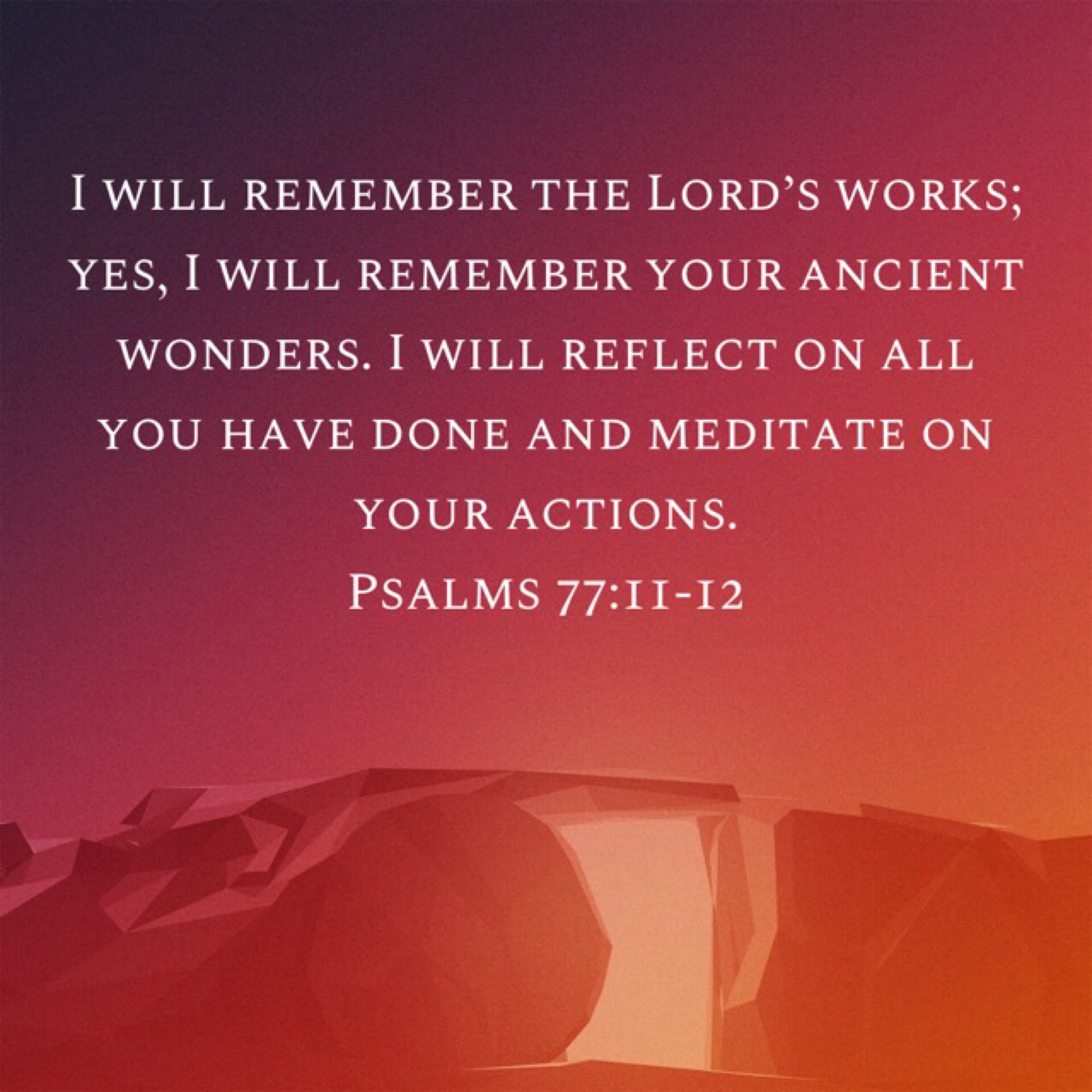
www.bible.com/1713/psa.77.11-12.csb

What has God done for you lately? The Psalmist is lamenting that God’s attitude toward Israel has changed. He is going through a hard time right now and He feels God has turned away from them.

But then he remembers that God was not always like this. God did great and ancient wonders for the people of Israel. For them, it was the crossing of the Red Sea when the Egyptian army was pursuing them. He remembers fondly the great stories from Israel’s last when God was gracious and faithful. The Psalmist doesn’t satisfy his question though, as if he is still writing in the midst of his sorrow before God at last lifts the burden. No.

So the question he lays before God and the same question that we lay before Him is this: have you forgotten us? His answer to his own question is this: He did not. There were times in Israel’s past when their situation seemed dire. And God redeemed them, saved them from their peril. God has been faithful.

Will you trust Him now? You are in a situation now where it seems you are in peril. If God feels far from you, what miracle can you remember in your life that reminds you that He remembers you? The caption above include a view of an opened tomb, a reminder that Jesus rose from the dead for you. He died for your sins, offered you forgiveness and the gift of the Holy Spirit. God can’t forget you. He lives in you. God can’t ignore you. He is present with you. Remember what He has done for you and whose you are. God is very jealous for His own. He will not lightly let you walk away or suffer trouble. If you are going through something right now, there is a reason for it. “Now God . . . will personally restore, establish, strengthen, and support you after you have suffered a little.” (1 Peter 5:10) did you see that? Suffering is part of our growth. Remember that this world is not our final destination. We have much to do before He calls us home. Our journey will be fraught with peril and difficulty. But to whom will be given the greater crown? The one who called God foul every time they stubbed their toe? Or the one who persevered through many trials, depending on God to help him through?

You say the suffering is greater than I can bear. I empathize. And I’m sorry. But can I tell you that that kind of suffering was not designed for you to bear alone? God sometimes calls us to lay our burdens on Him, trust Him through the suffering, allow Him to bear the burden with you. That requires faith, and is usually what I need to work on when I feel this way. Faith that is isn’t tested isn’t faith at all.

If we trust Him, especially in the great and precious promises He has made, them can we trust Him in the ordinary day to day stuff we labor with?

I know this is long, but this is something that has been on my heart lately. I want to encourage you. If you are going through something right now please comment below so that we can pray together about it. You are not far from my thoughts dear reader.

God bless!

The Beginning of Wisdom

www.bible.com/1713/pro.9.10.csb

After listening to Proverbs, I have come to an understanding that wisdom (the understanding of how things work generally, including human relationships) includes physics and observational science. As the Bible uses this word, it assumes that wisdom begins with God (the author of wisdom and of all things) and we learn it by paying attention. For example, Solomon instructs the sluggard to observe the work of ants in collecting food. Solomon is employing the natural world for moral instruction. If the ant can collect food for lean times, then ought not we do the same? That is arguing from lesser to greater based on a natural truth. Solomon learned much wisdom by observing the order of God in the created world. Newton and Galileo also observed the same. Wisdom is more than knowing the right things to say, but in this ancient sense, to know why things are the way they are. This kind of wisdom does not begin with assuming we know better than God.

God bless.

One of These Little Ones

www.bible.com/1713/mat.18.6.csb

““But whoever causes one of these little ones who believe in me to fall away — it would be better for him if a heavy millstone were hung around his neck and he were drowned in the depths of the sea.”

‭‭Matthew‬ ‭18:6‬ ‭CSB‬‬

https://www.bible.com/1713/mat.18.6.csb

God is looking out for the little ones. He is watching those in whose charge they are. Caring for a child is made a grave responsibility here. Children are not insignificant. They are not pests or bothers, or inhibitors to a good time. Children are not a burden. Children are a privilege. Many people can’t have them. Those that do often renege of their responsibility in favor of their own good time.

When my wife and started having children over 20 years ago, we were both excited and afraid. We’re excited because we were going to be parents and enter that rarified space known only to people with children. But we were, and still are, afraid. Raising a child is like building a nuclear bomb. There are a lot of small pieces that go into it. Sometimes you have to be tough, and other times you have to be gentle, and in the end, you still have he potential for disaster, but if you did your job right, you have unleashed upon the world a great power for good. It can be powerful and respected, or it can be desctrucrive, even destroying your world too.

Children are precious. Take care of them.

God bless.