Just as God

I probably don’t need to remind you first that as Paul is writing here, he is writing to a church, where these behaviors are beginning to surface. This is a church that has lost its passion for the gospel and has settled into a pseudo-legalism, where religion is about following rules, rather than being obedient to God in faith.

Paul’s list of evil interaction is as follows:

  • Bitterness (acridity or poison) It’s not hard to imagine this person, as every word they speak is dripping with criticism. You can do nothing right about these people. Even if you do something right, you did it by accident.
  • Anger (violent passion) – This is a person whose anger flares up quickly. I’ve seen this in board meetings, and it’s not pretty. Such people are toxic to the faith, and their brief flashes of anger hurt other Christians because this person has no self-control.
  • Wrath (indignation) – This person wears their offense as a badge of honor. They are always offended, and even the slightest word can set them off, so you walk around them on eggshells, trying not to offend them again. They use their anger as a means to control others.
  • Shouting (crying out, intimidating speech?) – This is the loud-talker, because they know if they talk loudly, they will intimidate others. They like to dominate their conversation and their point of view is the only one that matters.
  • Slander (literally blasphemy) – This person has taken what little they know of the faith and use it to their own benefit. They are the kind of people who will tell you that if you give them money, God will bless you. They will salt their speech with just enough platitudes to encourage trust, but their “truth” is all about themselves.
  • Malice (depravity, evil) – This is the dark-hearted individual, who for whatever reason (usually past trauma) works to undermine and destroy your growth as a believer.

And his list of favored interaction is:

  • Kindness (graciousness) – There is no end of kindness with this person. They will be kind to you, even when you haven’t been kind to them. They are kindness without fail, and these are the ones that remind you what Jesus is like.
  • Compassion (deep-seated kindness) – These seek out those in need, those in pain, and actively work to relieve it.
  • Forgiveness (favor, pardon) – These are the ones who are never offended by you, accept you as you are, and love you because you are made in God’s image.

Paul’s remind to the church in Ephesus is to avoid the behaviors on the first list, and seeks the behaviors of the second. When you take Paul’s advice, you will find your church becoming a church people come to because the Spirit of God is there, where a person finds love and peace, and you will find a Church just as God intended.

May God bless you and your fellowship tomorrow!
No One and Everyone

www.bible.com/1713/1th.5.15.csb

What are a Christian’s relationship to society at large? I know that in the church we are to “love one another” just as Christ loves us. We are to treat one another as brothers and sisters. That being said, I have to say a few words.

Today the mandate for wearing masks in public was put in force by the most high and benevolent Lord and Master Beshear. In his great love for the people of our beloved Commonwealth, and in spite of his own need for freedom, he has unilaterally ordered that all people must wear masks in public to further prevent already declining virulence of COVID-19. This was not an order in force when the virus was at its height, but now when the actual threat is diminishing. COVID-19 has indicated that it is no more dangerous than the flu, and even less so, as it kills less people than the flu. However, that is not the point. The point is what this verse says about this mandate.

“Always seek to do good to one another and to everyone”. If this is a command from Scripture, then it is non-negotiable. Today, because of our beloved leader’s order, our own church, arguably a private organization and free to resist orders of the state within its own walls when it conflicts with worship (Freedom to exercise religion is still in effect) decided to take the path of least resistance. Our church has not opened back up since March, relying completely on online services, which I believe is to the detriment. Many other churches in our area have reopened, and we have been attending them. Our church has decided that mask-wearing will be mandatory for all attenders and volunteers. And it frankly peeves me. I have to wear a mask every day I work (at the hospital, whose own mask-requirement is about a month old). I have been told that masks are important, but the principles of wearing masks to stop COVID infection are ludicrous. I have been asymptomatic for months. I have no droplets to spread COVID. If I was sick, I would stay home in quarantine. I am not sick.

If I had AIDS, and I knew I had AIDS, and then went about spitting on people in order to infect them, that would be intentionally doing harm and would be reprehensible. COVID is not AIDS. COVID is so much less lethal than AIDS (0.05% versus 100%) as to not even be comparable. Who is out there saying we need to wear masks because of AIDS? Tuberculosis? Pneumonia? Flu? Measles? Small Pox? Anything? Not one. For none of these diseases (not even the dreaded Ebola just a few years ago) have entire states been forced to wear masks. Read that again. Only with COVID-19, are far less lethal virus, who for many, the only way you know you have it is if you have a test (which tests for all Corona viruses, not just 19), have entire states been told they have to wear masks in public.

If the glorious leader had said, “You can wear masks if you feel you need them,” then freedom would be left in the hands of the individual. I would be okay with that. If he said, “Stay at home is you feel sick.” That would be find with me. That’s how we treat every other disease. But this state mandate?

Some will say that we ought to wear the masks to help people feel safer. That we will appear to be doing good. I’ve seen the masks people wear. I don’t buy it. I wear the mask all the time. I don’t like it. So when it comes to my church mandating masks for worship?

There is one passage in Scripture which speaks to an issue like this. It is a passage in 1 Corinthians which suggests that believers who are more mature ought to make concessions for those that are weak for the sake of unity. For the sake of unity, even though I despise it, I will wear a mask if it means that we will worship together again. If modesty says I need to keep certain parts of my body covered, then covering one more part will not matter. As angry as I am with all of this, if it hurts my brother in Christ by not wearing a mask, I remember that I have made other concessions for the sake of unity, concessions dearer to my heart than this one.

What about my brother who says it hurts him for me to wear a mask? I can only plead unity.

My Lord and My God, King of Kings and Governor of Governors, may You grant me the patience to deal with my weaker brothers for the sake of unity. I know I don’t have it yet, but for the sake of my fellowship and where I worship, I feel this is the path of “do good to everyone”. Father if there is greater wisdom, please teach me. For I trust in You and Your word above all else. In Jesus’ Name, Amen.

Without Holiness

www.bible.com/1713/heb.12.14.csb

“Depart from me, I never knew you” is probably the most scary phrase you can ever hear from God. But this is a close second. “Without holiness no one will see the Lord.” I may have good news, in that in Christ, we are made holy. He covers us with His holiness. And that ought to be important to you, since you have no ability to be holy on your own.

Holiness is purity and separateness. Your mother may have had a set of dishes that she only used on special occasions, like when the President came over to visit. Those dishes were kept separate from your “everyday” dishes in a hutch or a cabinet. In your whole life, you may have seen them used once a year, if that. Those dishes, by definition, are holy. Holy is the antitheses of common. In a religious sense, it is the antithesis of secular, or worldly. The farther we go from a Christian worldview, we find less and less holiness. What was once holy is now often considered ordinary. Instead of Sanctuaries, we have Auditoriums. Instead of prayer time, we have share time. Few things have been able to hold on to holiness, largely because our view of God has been diminished. Our sacred music is so like our secular music, that we often cannot tell the difference. Our sacred spaces look ordinary, instead of majestic. We have few sacred spaces anymore. And we need that.

Yesterday, I talked about the prayer closet. We need prayer closets again, just to have a sacred space in our lives. A special place that is God’s alone. The longer we neglect it, the harder it is to regain it.

As a Christian, I mourn the loss of sacred spaces. Maybe it attracts more people to Jesus. But its hardly something that Christians find inspiring, who wish to be unstained by the world. Christians who seek holiness will find it evermore challenging in today’s world to find it, unless they rediscover for themselves the holiness granted to them from Jesus Christ.

Heavenly Father, help me regain the sacred spaces in my life. Help me find that sacredness that I’ve lost, so that I may see the Lord. I know there is no greater tragedy than to have served my whole life only to fall short because I did not know holiness. Please help me rediscover it so that I won’t lose it again. In Jesus’ Name I pray, Amen.

Unseen

www.bible.com/1713/mat.6.6.csb

What do you tend to keep out of sight of others? I imagine they are things that you would not want most people to know about. Most people tend to keep their vices to themselves. They can’t handle the scrutiny of others’ eyes. As a rule, folks hide stuff that they don’t want other people to know about. Funny thing is, it seems that exactly what Jesus is telling about our prayer life.

Now if you are like me, you grew up in church, and offering a public prayer was just part of the service. Leaders in the church offered prayer and they tended to ask for the Lord’s blessing on the service, or a blessing on the sick and so forth. Growing up in church taught me that prayer, when offered, ought to be offered as part of a service where others could see and hear it (and get bored by it if it went too long).

But Jesus offers an alternative here. He counters the then-public notion that prayer was to be offered in public, on the street corners, where others could see and hear. His reasoning is that when prayers are offered in such a fashion, they are offered to get the attention of others, to point to the holiness of the one praying, and to receive praise at such holiness. I doubt that’s a problem today. We are hard-pressed to get people to pray today at all.

But in both those days and today, Jesus is calling us to a fervent prayer life. I think it might be comparable to the intimacy we share with our spouse. With the degree of intimacy we have, and the passion we share with out spouse, Jesus is calling us to have such a passionate prayer life. We ought to have such fervent prayer and intimacy in our passionate seeking the Lord’s presence that the tears and the sighing and all of our deep soul’s emanations that we just don’t want others to see it for embarrassment. I have had that kind of prayer. It is the kind of prayer where your soul both aches and yet is strangely warmed.

Lord Jesus, I need that kind of prayer life. May my prayers be so passionate for You that I can’t bear to share them in public, but that in my prayer closet, I honor and lift up You. Lead me to real, soul-filled prayer, that I won’t be surprised when I see you face to face. In You Name I pray, Amen!

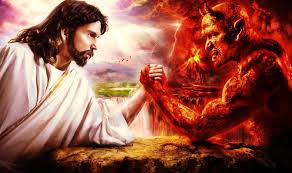
God and the Devil

I had a conversation some time ago with a patient that went something like this:

Proposition A. “God and the Devil are the same person.”

Why?

Proposition B. “People blame God for some things and they say the Devil caused other things.”

So it’s like two sides of the same coin. It made absolutely no sense to me. So in making conversation, it was something like this: God causes storms and illness, and Satan causes storms and illness. If the we have the same effect, we must have the same cause. If she’s right, then there no hope, because how can you have a God who judges evil if He is the source of the evil? How can God consign His own being to Hell? It just doesn’t make sense when you start to think through it. This does not solve the problem of good and evil, and it does not satisfy the issue that we know in our hearts.

Proposition B above is often applied to acts of nature or natural evil for which there is no human cause. i.e, storms, illness, freak accidents. But what about personal evil? Stuff we are tempted to do, or is done to us? If God and the Devil are the same, is there good and bad? Right and wrong? No, because they all come from the same source. And this violates our own sense of justice. If we have a sense of justice, then justice must be a real thing. But our sense of justice can’t be greater than God’s, can it? So God must be more just, and thus he cannot also be anti-justice at the same time. That violates the law of non-contradiction.

If we were only to take the proof of Proposition B, we might be tempted to accept Proposition A. However, there is far more proof to consider against Proposition A. While it is true that natural evil can come from Satanic influence (See Job 1) we also know that God uses catastrophic weather to judge evil (The Flood of Genesis 7). God sends plagues, causes the sun not to shine, parts the seas, and raises the dead. Satan on the other hand is known to afflict individuals (Job again is the example), and torments people. By his work, whole nations can suffer. David was tempted once to conduct a census, and because he did, God judged him for not trusting His faithfulness to sustain the nation, and offered David a choice of three judgments (this is in 2 Samuel). But Satan could not plague a whole nation, or send a flood. The two, God and Satan, may do similar things, but is a difference in scale. God can destroy the earth with a flood in judgment for sin. Satan can afflict a person with illness to tempt him to rebuke God. It’s very different after all.

And this doesn’t account at all for moral evil. Since we have a sense of justice, we know there is a difference between right and wrong. Every time we watch a movie or TV show, we know who the good guys are and who the bad guys are. It’s not hard. We can detect moral failure a mile away. With all of that skill, there must be some opposition between good and evil. They cannot come from the same place.

Also, Proposition A represents, though I doubt the speaker could articulate it, what is known as dualism. The Eastern religion of Taoism is probably the best articulation of this idea.

The white and the black portions represent good and evil, but both together form a whole. It was also popularized in Star Wars as the two sides of the force. However, in Star Wars, they never clearly represent it, as good is always implied to be the better way. That point of view doesn’t make sense in Taoism, as good and evil are both equal and equally powerful. This is contrary to Christian thinking, as it is very clear that God, the Creator, is uncreated Himself, and all things, even Satan, are created beings, making them inferior to Him.

Because God is the Creator, He has the authority to determine what is right, which necessarily are all things that agree with His nature. Everything that is contrary to His nature is considered evil. The universe declares the glory of God. Even without the Bible you can know that God is infinite, and infinitely creative. That He created surpassing beauty and wonder in the world around us. Even in us, He created beauty and grace, as we can tell between beauty and ugliness. When you read His word you find that God is a God of grace and mercy, forgiving sin and desires relationship with human beings through His Son, Jesus Christ. God wants all that is best for you, and is a ready refuge in times of trouble.

Satan on the other hand is consistently depicted as one who wishes you harm, wants you to reject God, and even in your own heart, you know there is always an influence desiring to tempt you away from what is good for what is sinful or evil.

How can God both encourage you to be better, and tempt you to be worse? Whose schizophrenic here?

I think it’s obvious that both Propositions are false. The first because it simply doesn’t fit the facts as we understand them, and the second because there is a vast difference in scale between “acts of God” and Satan’s schemes.

Waiting on God

www.bible.com/1713/hab.2.1.csb

Though not much is known about Habakkuk, we know at least that he was not happy with the way the Lord was handling things in regard to Babylon. He saw Babylon as a supremely wicked nation, and couldn’t understand why the Lord was allowing them to trample the Holy City, the City in which the Lord’s own Temple rested. Why should God use such wicked men to deal out judgment upon His people?

I echo Habakkuk’s questions, as the evil people I see around me are the ones who are tearing down American history, icons of our past which ought to be remembered. Why in this nation who has chosen to honor the Lord time and again are we being overrun by these wicked men and women who have stated plainly they want to destroy even the icons of the Church and rip out the stained glass?

But then I remember, Habakkuk may not have been seeing very clearly. Perhaps with rose-tinted glasses he was looking at the condition of his own people, a people who generation after generation had rejected God, and if not outright rejected, ignored God. Prophet after holy prophet had been sent to the highest kings and to the average man, “Repent of this wickedness of worshiping idols and return again unto the Lord Your God!” But the high places stayed. The Asherah poles and the altars on high hills continued to be used because the people had found other gods, less demanding gods, gods who would promise them ease and happiness, not the guilt of sin and the need for sacrifice. These were gods of complacency and indolence. These were gods who said what those people wanted to hear, echo chambers for their worshipers. Habakkuk may have been one the very few who was actually listening for God’s voice.

2020 has proven to be a year of consequences. We have laid the seeds for all of these things over the last few decades. Children who were not taught to respect American history, have now come to despise their own country and tear down its icons. Our willingness to not discriminate who can come in to our country has resulted in pandemics that started in other countries that found their way here. Our willingness to be open to every influence and thought without asking if they are true has led to the complete chaos that is out political system, and the men and women who say they represent us. We have held neither the politicians nor the media who report on them accountable to truth, and they have gotten away with murder.

When a nation turns its back on God, God slowly lifts His restraining hand from evil. Evil grows and becomes rampant, so that not even a well-armed police force will be effective to stop the evil of men’s hearts. It will not take an army from another country to defeat the United States. We will collapse from within, hollowed out like the corpse of a tree, alive on the outside, but dead and rotting within.

Is it reversible? I believe it is, because is still sending voices, His messengers, to be heard in our nation. He is still calling us back because He has not finished with us. But like the period of the Judges, he sometimes allows evil to invade until the people cry out for mercy and salvation. I believe that is where we are right now. America has been brought to it’s knees. We are not out, but we are down. And I would pray for America to realize the mess it’s gotten into and call back to its Savior and Lord. Enough with this abortion nonsense. Enough with the gay and trans agendas. Enough with the destruction of the family! Enough with drugs and addictions! Since we are on our knees, let us repent of the evil we have done one to another and repent unto the God who makes us a great nation! We have dabbled in the darkness long enough. It’s time to return to our Father who stands waiting for us, looking for our return.

Heavenly Father, I know that as a nation, we have crossed the line way too many times. We have demonstrated faithlessness. We have demonstrated our faith in armies and science and our own sense of right. Father we are wrong. And even now we are seeing the consequences of our wrong actions taking place around us. This isn’t about George Floyd. This is about justice. This is about the righteous justice of God being poured out on a wicked nation, not because they had slaves 200 years ago, but because of the evil we do to one another today. Lord I pray, please hear our repentance, please forgive! Please show us Your unmistakable love for Your people! Lord may we pray these things together in our hearts directed to You. In Jesus’ Name we pray, Amen!

Wounds

www.bible.com/1713/isa.53.5.csb

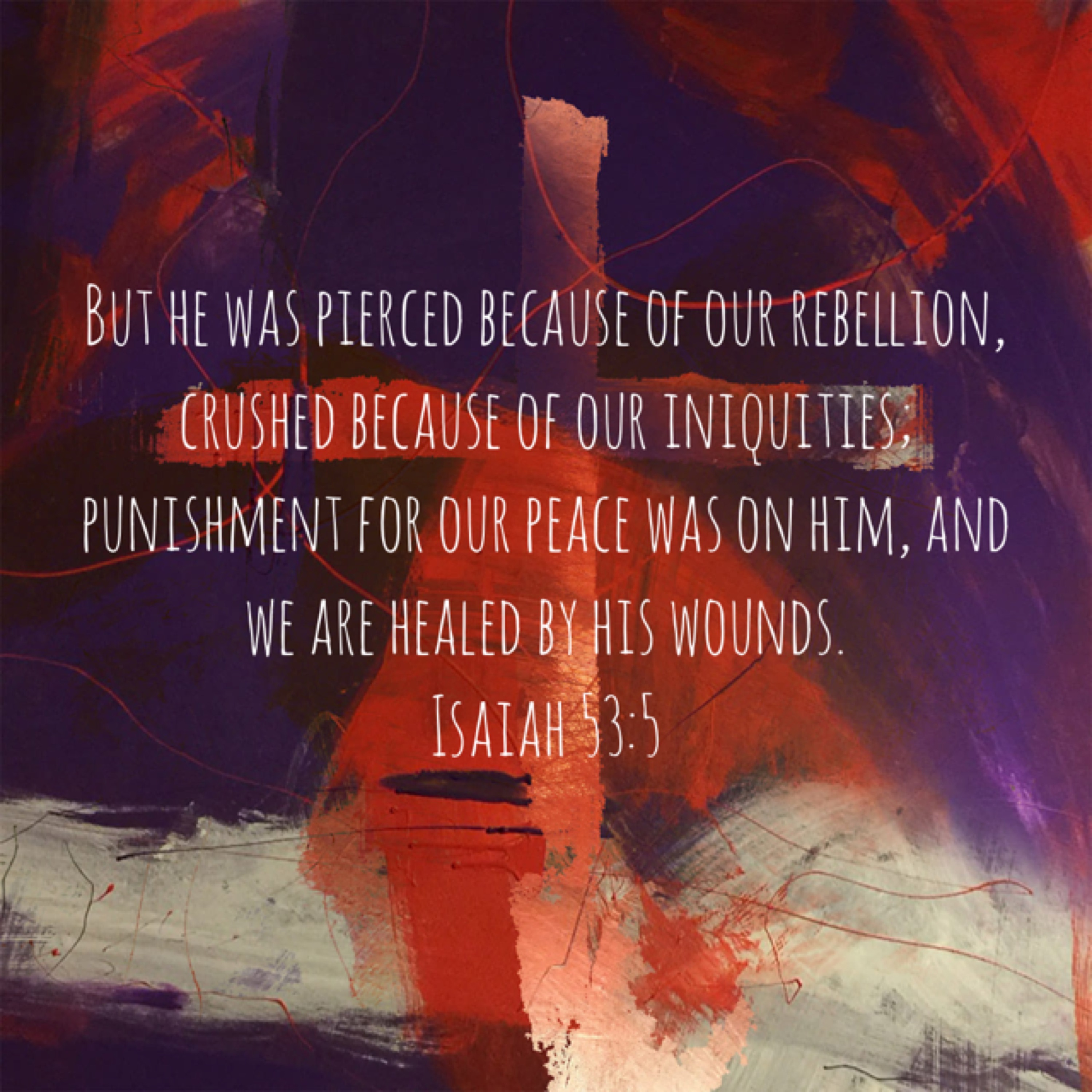
If you’ve lived any length of time, you will have experienced your share of wounds. When I was a teenager, I took out the trash because my mother told me to. Little did I know, a piece from that trash bag had cut into the side of my hand, and even today I can see that scar. I have other scars, evidence of wounds I’ve suffered in the past, and each of them tell a story. Somehow, we manage to survive our wounds to bear the scars.

Jesus had wounds, the worst of which He experienced at the cross. He bore wounds from the lashing of the whips and scourging. His back was laid open to the bone from the intensity of that punishment, but at least He could still breathe, though blood loss was going to complicate things. He bore wounds on his scalp from the crown made from a thorn-bush. The thorns were easily two inches long and were thrust upon his head in a grotesque mocking of his true royalty. He led through the streets of Jerusalem, humiliated by the crowds, bearing the wounds of their insults and derision. Finally, the wounds that would scar Him forever, nails were pounded into his hands and feet into wood, and there held aloft on the cross. There, He could not breathe, but for a few strangled gasps. Still, He stayed there three hours, bearing the insults of the religious elite, and even those who called Him the “Son of David” and cried “Hosanna” just a few days earlier. He died there, asking His Father to forgive them.

A week after He rose from the dead, He appeared to Thomas, who doubted that Jesus had actually risen. Jesus appeared to Thomas and asked him to touch where the nails had bit into his hands and feet, and where the spear had been thrust into His side. He said this to prove to Thomas that He was the same Jesus who had died, and not an some heavenly imposter. Thomas said the only thing he could have, “My Lord and my God!” The resurrected Jesus bears the wounds He suffered for us for eternity. Just as He continues to save us from our sins, so He continues to bear the wounds that delivered us from sin. “By His wounds, we are healed.”

Just as your wounds tell a story, so do His. His tell the story of His great love for His brethren, His love for His bride. It seems that we too have this story to tell of the wonders of His great love.

Dear Jesus, thank You for reminding me today that I am bought at a great price. Just as the story of the man who found a pearl and sold all that he had, So You gave all that You had to purchase me. I am no longer my own, but I am Yours. There is a divine slavery, in which the Owner bought His servants with His own lifeblood, and the servants are forever grateful. May we each realize that our slavery to to our benefit and to the benefit of the world. In Your Name I pray dear Jesus, Amen.

The Company of Mockers

www.bible.com/1713/psa.1.1-2.csb

I have always loved David’s progression in this passage, from wicked, to sinners, to mockers. It is a progression from passive to active in their wickedness. The wicked are those whose mind is turning from good to evil. They are thinking about wicked things and working things out. The sinners are those who’ve taken up the mantle of wickedness and sinned against God. They have tired of the cramped Laws and openly rebelled against their Lord. But the last group, the company of mockers, is the worst of the lot. Not only are they wicked, and are sinners, but they they mock the God of heaven. They have denied God, for they know the penalty for their actions should God actually exist. This is why (some) atheists actively hate God and Christians, even they don’t “beleive” in His existence. They must continually deny what their own spirit tells them, forcing them soul down into dark places so that their “reasonable” mind can drown out the evidence that surrounds them.

But atheists are not the biggest problem for Christians, not by long a long shot. For Christians, our biggest problem is ourselves. As David writes, there are plenty of opportunities to walk in counsel of the wicked (“try this, do that! No one will find out!”) or to stand with sinners (“Sin isn’t so bad once you get used to it. Don’t you have a God who forgives sin? What’s one more sin?”) or to sit with the mockers (“You call yourself a Christian? Then why don’t you . . .?”) As Christians, we certainly feel the pressure from the world to be more like them, to fit in and conform so that we don’t stand out.

But what is the strength of the Christian? The written word of God. In this we meditate, day and night. In the Word we find a ready defense against temptation, just as our Master did. A Christian who is equipped with the Word will never find it failing, but it will always provide an answer when your faith is challenged.

I’m sorry to say, but the greatest threat to the Christian isn’t the world, but the ease of which Satan’s arguments can slip past our defenses when we don’t know the word of God. If we don’t study the book, we will be wide open to attack. Be diligent to study the word of God so that you will not be unprepared in the day of temptation.

Dear Lord, help me strong in the face of certain attack by the evil one. I know you have laid out for me everything I will need to know in You book. Help me each and every day to open Your word and apply what I’ve read to my life, so that my gaps will close and I will stand in the day of temptation. In Jesus’ Name, Amen.

Shifting Shadows

www.bible.com/1713/jas.1.17.csb

Over the course of the day, the shadow cast by my home changes, from direct sunlight coming in to my office space in the morning, to the deep shadows of the evening, where the sun has gone over the house and and allowed this side to cool. When I am working outside in the yard, I welcome this shadowing of the back of the house, as it means that it becomes a little cooler to work.

Shadows are never still, but change throughout the day. The cooling shade of a tree at one point of the day recedes until you are bathed in sunlight, and during the summer months that can be uncomfortable, unless you are like my wife. She relishes the sunlight as it bakes her skin and turns her brown, and is only frustrated when the shadows begin to creep over. But such is the nature of shade and shadows.

What a contrast then it is to see that God is not like that. His light is bright and constant. His gifts are faithful and true. Our God is the standard of reliability. There is a saying, “reliable as the sunrise”. but the sun gets its cue from the Lord.

Do not set your hope that things that will change. The memories you saved to videotape a couple decades ago have to be transferred to digital, just so you can see them. In another couple of decades, it will be something else. The job that you thought you would work until you retire? They will be bought out, your insurance will change, and you may be looking for another job. That church you worship at today? Though all seems wonderful and bright, the preacher will grow old, retire, or be replaced, and everything will change again.

God alone is the unchanging constant of the universe. If you would set your hope on anything, set your hope on Him. Let your reliability come from Him, and not your hope in changeable things, human institutions like government or church. Be the influencer in your church, in your community because of the solidity of your hope in God and His provision. Show others the hope you have, the certainty you have in the Father of lights, and they will learn to trust in Him too. For that is why we are here, why He saved us, so that we could chow to others the hope we have within us.

Heavenly Father, from whom there is no shadow of turning, who has granted me every good gift and is hope for the future, may You offer hope to all who are reading this, who know better than to trust in changeable things, so that they may put their faith and trust in You. Thank You Jesus for saving me from the uncertainty of life and showing me promise of eternity through You. I pray these things in Your Name, Amen.

Perhaps

www.bible.com/1713/zep.2.3.csb

I feel a bit more certainty than my brother the prophet Zephaniah. On the Day of the Lord’s anger, which many feel is even today, I know where my soul is going.

Righteousness and humility both seem to be at the heart of this text. This isn’t a relative righteousness where you compare yourself to your neighbor and tell yourself, “At least I’m not as bad as that guy.” This is an absolute righteousness, where the standard and model you compare yourself to is Jesus Christ. God does not grade on a curve, but on grace. He knows you cannot measure up, so He sent His Son to die on a cross for you, so that you would believe on Him and accept His gift of righteousness in exchange for your filthy rags.

For humility, I can think of no better example than the Holy Spirit. Consider that the third person of God, co-equal with God in every way, calls no attention to Himself. God the Father is the Creator, the Provider, the King of the Universe. Jesus the Second Person of God is the Savior, the One who rose from the dead and offered eternal life to all who believe. But the Third Person of God, the Holy Spirit, simply points to the Father and the Son. He does not glorify Himself or point to Himself, but points others to the Father and the Son. I think this is why there is such stern penalty against blaspheming the Holy Spirit. All the Holy Spirit wants to do is to bring us through the Son to the Father. He doesn’t ask for praise or worship Himself. I think in many ways, the Holy Spirit is the humility of God, and the reason He calls us to humility. As much as there is glory, laud, and honor for the Father and the Son, there is humility in the Spirit showing us what it means to be co-equal with God, and yet desire only that you give glory to the Father and the Son. What would it mean for your life if you only worked to bring people to the feet of Jesus, instead of taking any praise for yourself?

No one of us can live up to the standards set by God in Christ and in the Holy Spirit, but thankfully, Jesus came and lived out these ideals for us. We then trust in Him to school us and raise us up according to His word, that in every day and every way, we work to be more like Him. Let us praise the Name of Jesus before the Father!

Lord Jesus, thank You for taking this one for the team. Because of You, I have a chance, no, a certainty by my faith in You to spend eternity with You in Heaven. May every day be a day that I give honor to my calling. In Your Name I pray, Amen.