Obedient to Death

www.bible.com/72/php.2.8.hcsb

Nothing shows us the dedication to the mission like a willingness to die for what you believe in. Really, nothing else, not giving of bast fortunes or sending many others to fight. Nothing shows your dedication to an ideal by offering your own life as forfeit. It says that your belief is more important than life itself. We call such people martyrs.

So what did Jesus die for? He died for sin, the perfect sacrificial lamb for the sins of the world. He died for men, dying in their place to remove the pall of judgment upon their souls. He died for Himself, so that He could restore the relationship between Himself and men through portal of His sacrifice. He died so that He could demonstrate His own love for men by being raised from the dead and showing God’s power over death. As you can see there were many things going on that day.

But I think the most important reason is that He died for me. He died for my family. He died for my friends, so that we could all live together with Him.

Thank you Jesus for being obedient unto death, so that you could show me how to live.

God bless.

Bread and Water

www.bible.com/72/jhn.6.35.hcsb

We live in an age where food is king. In our culture, food exists on every corner. Our question isn’t “can we eat today?” But “where do you want to eat today?” Our options are almost limitless. Even the poor have “food stamps” to make sure they don’t go hungry. We emphasize how and where we eat. We also put priority on the kinds of food we eat. Are we getting enough fiber? Are there enough greens? What about protein? Are there too many carbs or sugars? Is it gluten-free?

When Jesus speaks to the crowds in rural Galilee, the people He speaks to don’t have any of those options. They can’t just “go out” to get something to eat. Their food was earned by the sweat of their brow and the tool of heir hands. As Paul says later, “a man who does not work does not eat.” We have surely disconnected the two. For Jesus to offer Himself as bread and water to this crowd was saying to them, “I offer you the essentials of your daily life. I want you to receive me as such.” He is bread and water they do not have to labor to receive. He is as basic and essential to life as these, and He offers Himself freely to them, so that they could really live. He offers them life beyond the borders of daily struggle to life abundant, life everlasting.

Something we overlook in our daily regimen is vitamin J. Maybe it’s time we included Him.

God bless you today!

Jesus Triumphant

www.bible.com/72/luk.19.38.hcsb

Was it a victory lap? When Jesus rounded the last turn and gazed upon the city from the hilltop, did He think He was coming in victory? The people certainly did. They proclaimed “Hosanna” and “Blessed be the One who comes in the Name of the Lord!” Jesus arrived as a King would atop a donkey. He did not arrive on a charger or war horse, but on a donkey, in peace.

We call it the Triumphal Entry, the Sunday before Easter just as it was in that week before the Resurrection nearly 2000 years ago. We celebrate it as Palm Sunday, for they waved palm branches before the donkey’s path into the city. But was it truly triumph that waited for Jesus? The synoptic gospels show Jesus making his way to the Temple and clearing out the money-changers, in effect, declaring judgment on those who would convert the house of prayer into a den of thieves, a place of merchandise instead of worship. No one dared oppose Him because they saw Him as a prophet, and prophets often did powerfully symbolic things. And then Jesus left the Temple and went back to Bethany. Did He walk back?

Jesus’ triumph seemed to be fleeting, for in a few short days, He would be hanging from a cross outside the city. They would be calling for this prophet’s crucifixion at the top of their lungs. He would be scourged at the end of a Roman whip. He would be dead before the week was over.

It is not triumph as the world sees. That’s what happens today. The world sees a King who did not take his throne. They could not see the King who longed for the throne in each man’s heart. They looked for s politician, not a Savior. Jesus knew that true change would not come through laws and rulers, but by His own blood. Let us celebrate the triumph of a Savior, not over enemies, but over death itself. That is Jesus triumphant.

Stop It!

www.bible.com/72/psa.46.10.hcsb

Almost always rendered “be still and know that I am God” I think HCSB nails the original context here. “Be still” can be understood so many ways, and even applied to situation to which it was not intended, like Christian Meditation (which isn’t Christian if you were wondering).

“Stop fighting” drags this verse right back into context. The passage is about the peace God gives when He puts an end to fighting by His mighty power and protection. While God is a man of war (Exodus 15:3) He also puts an end to war. God’s demand here is cease this pointless rebellion against His and His people. He will win. There is no point in your struggle against Him.

We talked this week in Small Group about rebellion. We have this rebellion we acquire through our teen years (or even when we are 2) of resisting what anyone tells us to do. I have two teenage girls in the house. We have our moments. We hate being told by others, want to be captain of our own ship and so on. We only rarely acknowledge our need for a parent until we are out of our depth. At the same time, we deeply desire the approval of our parents, showing that we can do it on our own. It is hard to manage this conflict.

God appeals to our deep need for a parent, a father’s love. It goes much deeper than we are willing to admit and is satisfied only in worship. I challenge you this morning to “stop fighting” and surrender to the One who made you.

Love you all. God bless.

Reap a Different Crop

www.bible.com/72/psa.126.5.hcsb

The Bible affirms the law of sowing and reaping. What you sow, you must also reap. If you sow bad behavior, you will reap bad consequences. If you sow kindness, you will reap the same. All of that works pretty much as predicted. And then there is this verse.

If the law of sowing and reaping holds, sowing in tears means you will reap a flood of tears. You have to sow joy to reap the same. But this verse stubbornly refuses to comply with the law as we understand it. This is a promise from God.

So we also need to quote verse 6. 6  He who goes out weeping, bearing the seed for sowing, shall come home with shouts of joy, bringing his sheaves with him. The law still applies (this in a literal sense). As we go out to sow seed, we are weeping. When we go to reap, we are joyful at the harvest. Tears aren’t being down, but seed. Tears reflect our emotional state as we are in the act of sowing.

I believe that when they went out to sow, this grain seed represented the last of their food, a sense of security. To sow it meant to trust their last meal to God with only hope of a return. This is not unlike sacrificial giving, when you give when it hurts to do so. When giving to God means you will be giving up something else that you treasure. That would be sowing in tears. The promise here is that you will reap with joy when the harvest is finally tallied. This is consistent with the law of sowing and reaping.

God bless you today!

Revolutionary

www.bible.com/72/rom.1.16.hcsb

Jews AND Greeks? Are you serious? God wants to save both of them? What about the Romans?

Seriously, the power of God is the gospel. Without regard to piety, reverence, law-keeping and ritual, the gospel has more power than any of these. The gospel is a story. It is the story of an Almighty Creator God who wants to save His Creation, namely Man from his own rebellion. So God sends His Son as witness and testimony to the care and love of God. Man kills the Son in the ultimate act of rebellion. The Son rises from the dead in order to demonstrate His forgiveness for sin. He is the God who loves us despite our evil to compel us to change.

This requires of us in humanity a desire to return. Under the right circumstances and conditions, something in us will revive that had died. It is our love for our father. Our desire to be approved and loved by our father. Our desire to make our father proud of us. It is as deep-seated in us as our need to breathe. It transcends culture and language. And the gospel is the power of God to restore that fundamental relationship despite our sin and grief and guilt. It is God who forgives, who stands ready to receive us back when we’ve realized in the hog pen that being in our father’s house, even as a servant, would be far better.

I challenge you with the gospel today. I know this world is lost and broken. It has Daddy-issues. But the gospel is stronger. The world has rebellion, strife, murder and death, but the gospel is stronger. It is the power of God unto salvation. And it is ours to wield simply by telling.

God bless you today.

Prayer of Petition

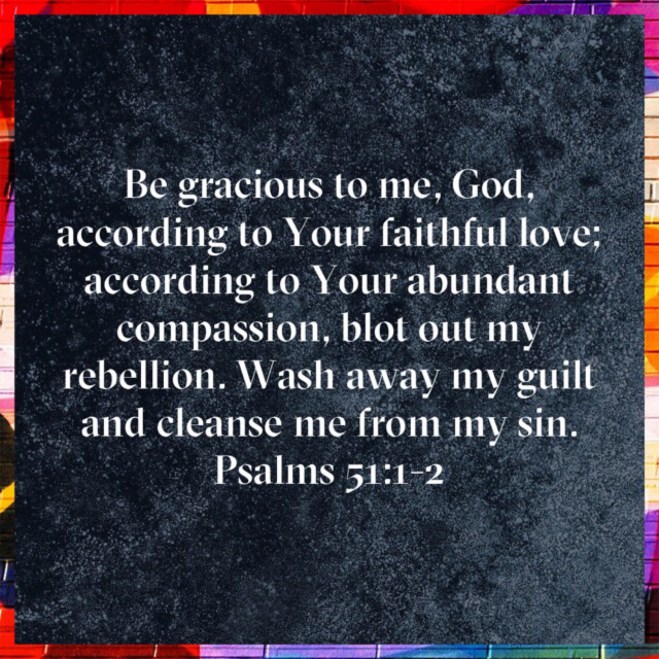
www.bible.com/72/psa.51.1-2.hcsb

Nothing hurts like a broken conscience. It’s when you can’t look a person in the eye anymore, or stand straight before others. When the burden of sin is a constant reminder that you are not a good person. It staggers the walk and stutters the speech. It points to depression and self-harm as the best answers for inner pain. Guilt will force you into decisions that you never thought you would make, and circumstances beyond your control. Who will save us from this body of death?

Thanks be to God for His indescribable gift! He heals the broken conscience and forgive even the hidden sins. He gives joy for sorrow and love for guilt.

Make today the day He heals your broken and contrite heart. Don’t carry your burdens any longer. Cast your cares upon Him, for He cares for you.

God bless!

Chastising the Nations

www.bible.com/72/zep.2.3.hcsb

So On first reading of this verse it sounds like Israel is at it again, and Zephaniah is bringing a word of the Lord to correct them. Not so. This is Zephaniah speaking to the nations surrounding Israel, who have been plundering her borders (often used by God to chastise the people of God) now on notice. What is amazing about this is that God is sending His prophet to warn Gentiles.

Unlike Israel and Judah, the Gentiles of the nations have no standing covenant with God, no Sinai moment, and no agreement of behavior with the Almighty, or so we think. On what standing here does God take the nations to task? They come under the covenant made with Noah back in Genesis 9, which applies to all nations. Among other things, Noah’s covenant covers the proper role of capital punishment, taking another’s man life. A nation that kills indiscriminately runs afoul of this covenant. If we know anything of the world of ancient Israel, human life was not precious.

My point is that God holds the nations accountable to Himself, even if they do not have the law of Moses. But as you see in this verse, He also holds open the possibility of salvation from His judgment. Seeking righteousness (according to God’s own standard) and humility, and individual might be safe from God’s judgment upon the whole nation. In this the Jews did have the corner on righteousness, for even then, salvation was found in their teachings of the law (to the extent one could be “saved” through animal sacrifice to the God of Israel). All the world received a covenant through Noah. But only Israel had a way to deal with sin against that covenant. All the other nations invented religions of appeasement that were ultimately false. Only Israel had truth. Thus, seek the Lord (of Israel) and His righteousness and you may be saved. Sound familiar?

It is the same call to the nations today. Seek the Lord (Jesus) and you will be saved by Him through faith. Instead of the incomplete sacrifices of animals, we have the perfect sacrifice of the Son of God which covers all sin for all time. Praise be the name of the Lord who cares even for those not called by His Name.

God bless you today!

The Kingdom of Heaven

www.bible.com/72/mat.18.3-5.hcsb

Recently I have been plagued with this concept of the Kingdom of Heaven, what it is, what it means and it’s relationship to the Church and so on. I have always thought that the Kingdom of Heaven is the Church, at least in its ideal sense. There is only one Church, just as there is one Kingdom, for there is only one King.

When Jesus came preaching the Kingdom of Heaven, He was the ideal herald, as He is the King. Thus He decides who is allowed to be a part of His Kingdom. As the above text illustrates, Jesus accepts faith as a little child as entry into His Kingdom. Now this includes the fine print, as the text says above, whoever converts and becomes like children. Conversion is a messy and complicated business, putting aside old beliefs and adopting new ones, disengaging old gods and encountering the new One. But this is the port of entry into the Kingdom. Jesus died and rise again so that others could enter His Kingdom, by faith, and this become His disciples, His ambassadors to the world.

We preach a coming Kingdom, but in part it is already present. We are it’s outward visible manifestation. If we are not doing our job and promoting it as a desirable alternative to the world’s lusts and trouble, then what are we doing?

Please consider your role today in the Kingdom. God bless you on this Monday.

Answer to Climate Change

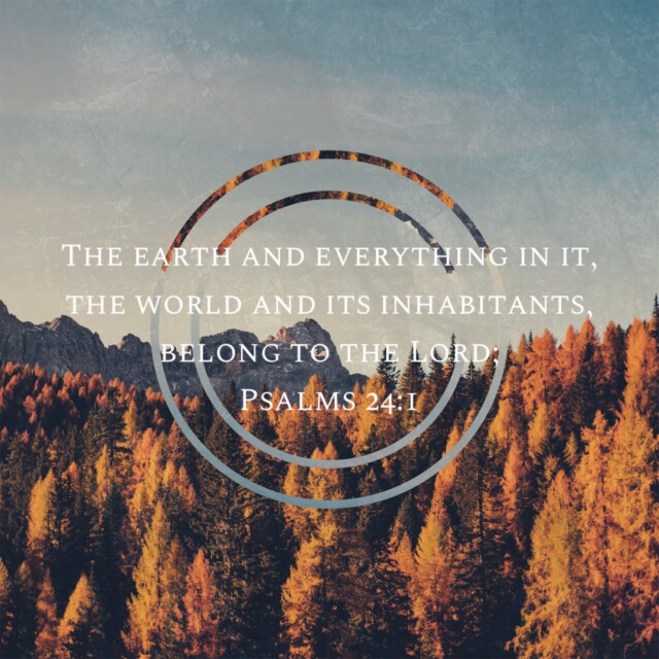
www.bible.com/72/psa.24.1.hcsb

Found one! Talk to the Owner. Worried about changing climate and weather problems? Worried about the world getting too hot or too cold? Talk to the Owner. In other words, though there are many things we can do to be good stewards of the environment, only God has the power to effect real change.

One to chew on today. God bless you on this glorious Lord’s Day!